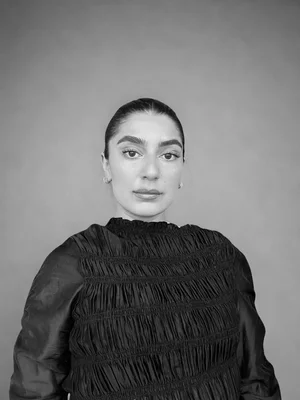
Charlotte Moraga on Legacy, Stewardship and Finding the Sam
In conversation with San Francisco-based Kathak artist, choreographer and Artistic Director of the Chitresh Das Institute, Charlotte Moraga, on three decades inside a living tradition, the weight and privilege of carrying a legacy forward, and what it means to keep innovating from within the deepest roots of the form.
Written by Simi Kaur
All images courtesy of Charlotte Moraga
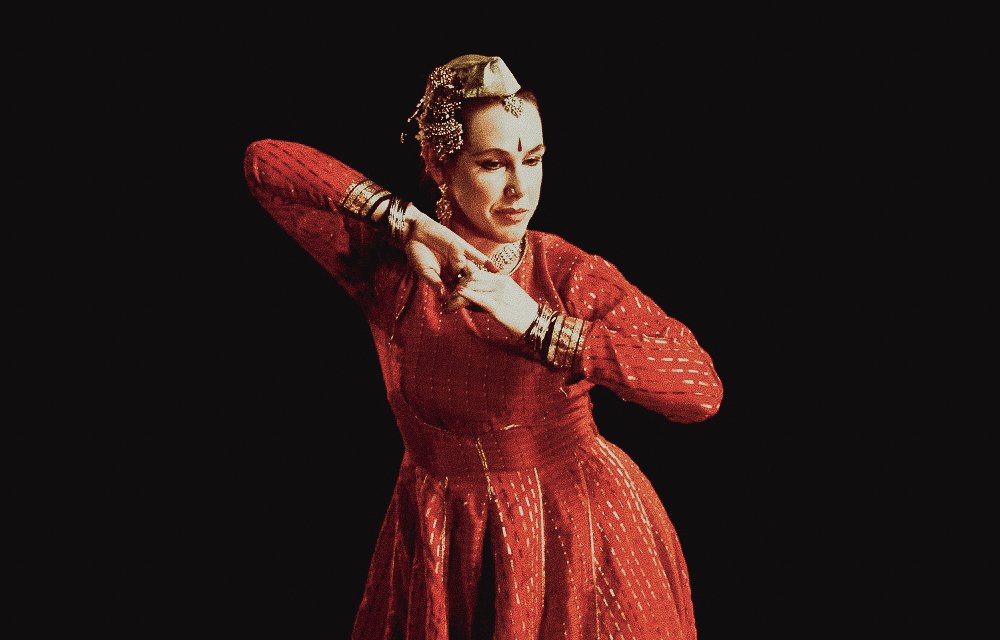
Photography by Marty Sohl.
In 1992, Charlotte Moraga walked into a two-credit Kathak course at San Francisco State University without knowing anything about the form, or about the man teaching it. What she found was Chitresh Das. "He was such a compelling artist and teacher," she recalls, "that I said to myself: whatever he is teaching, I have to learn." She could not have known, in that moment, that she was stepping into a relationship that would define the next three decades of her life, and that she would one day be entrusted with carrying his legacy forward.
More than thirty years later, Charlotte is one of seven disciples with whom Das tied strings in the sacred Ganda Bandhan ceremony. She is a former principal dancer and soloist in his company, a touring solo artist, and the Artistic Director of the Chitresh Das Institute, which she co-founded in 2017. Hers is a practice shaped by immersion, loss, devotion, and an ever-deepening commitment to a form she did not grow up with, but which has, over time, become inseparable from who she is.
Finding the Sam
“Upaj is the heart of the tradition. You have a structure in mind, but you leave space to just be in the moment and really connect with the music and audience.”
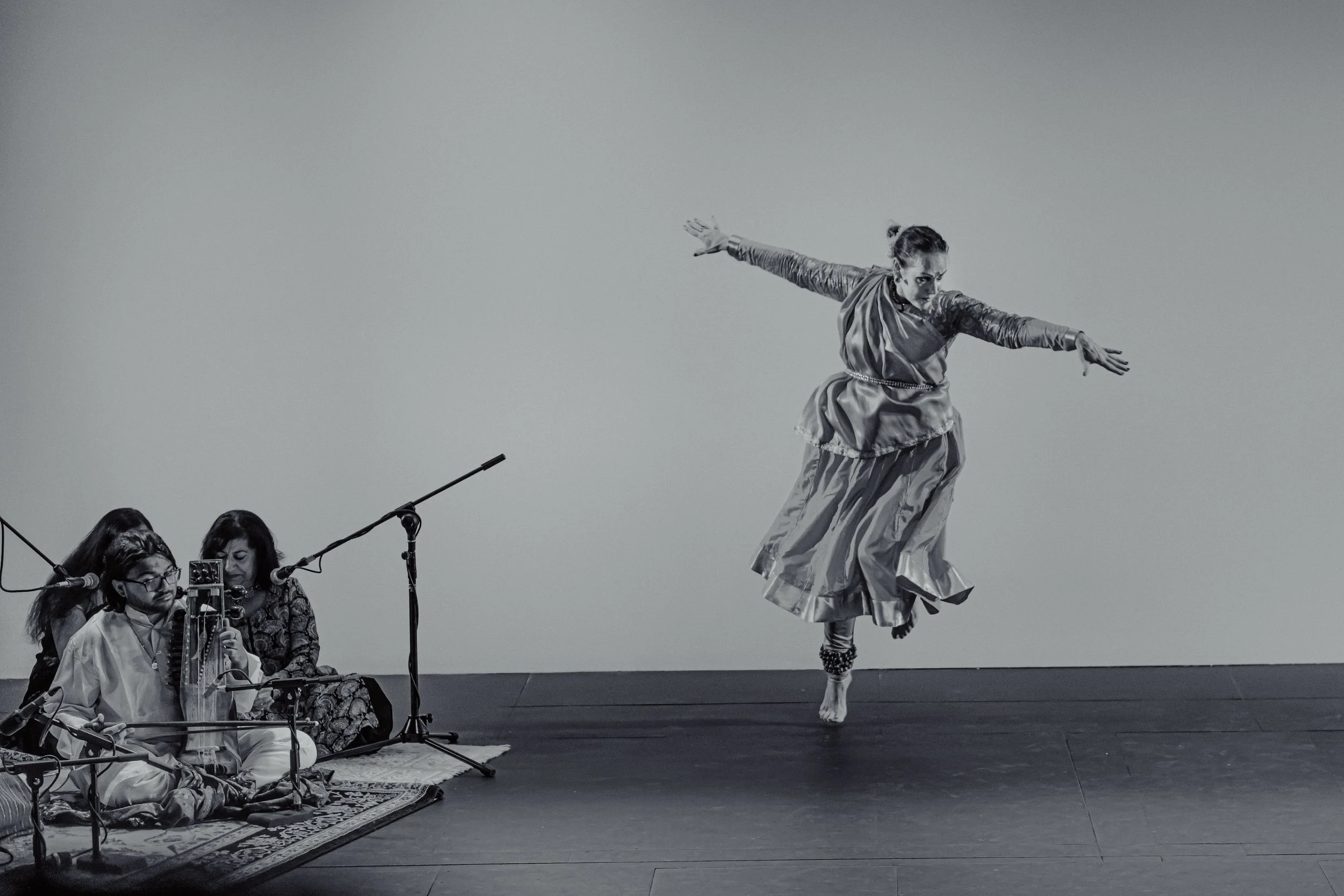
Photography by Ravi Kohli.
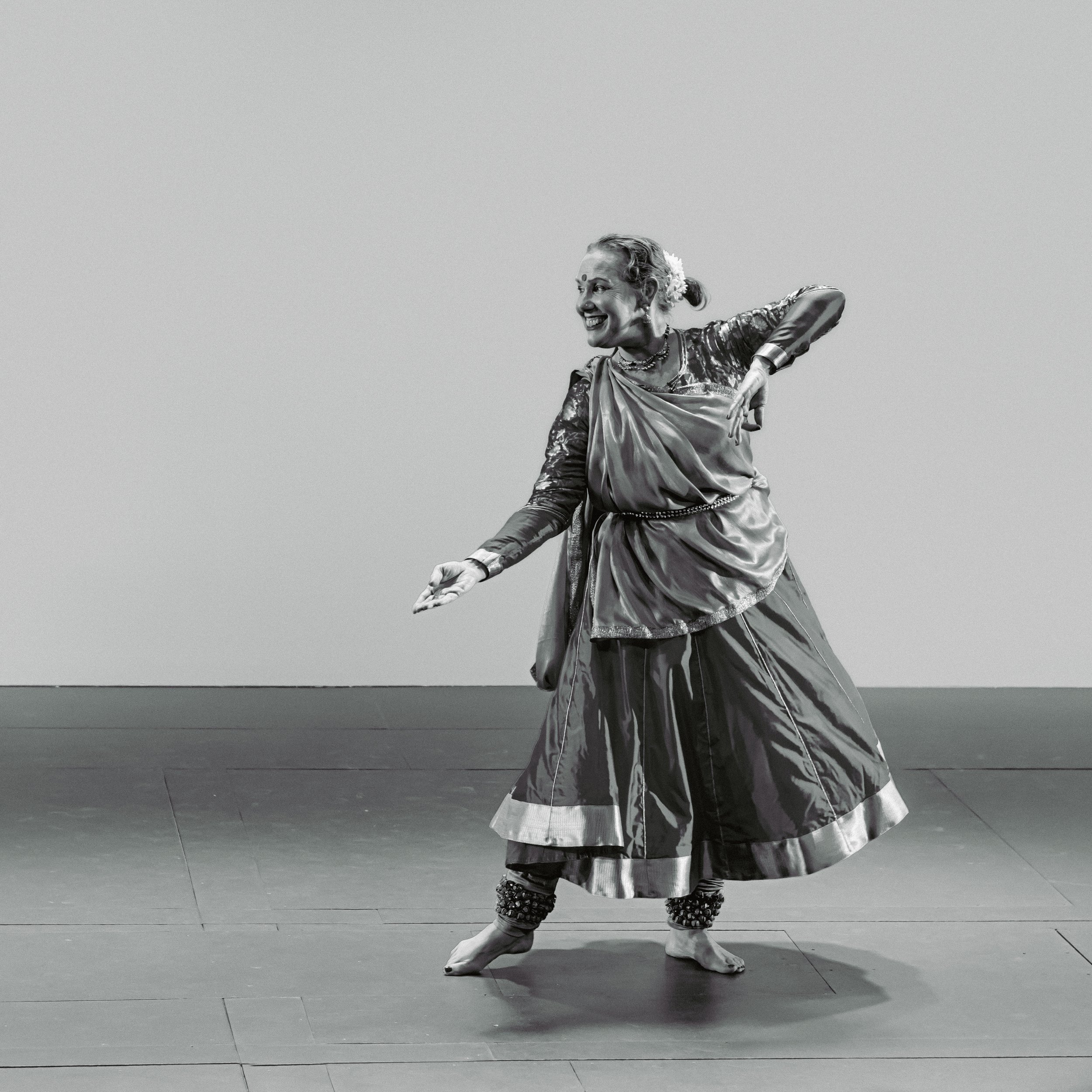
Charlotte came to Kathak having already danced since childhood, and so certain aspects of the form arrived quickly. Chakkars (pirouettes), she recalls, felt like flying. Within months she was executing triple turns. "It took me a few years to really find the sam," she reflects. "But once I did, I was obsessed."
What she was entering was, in her teacher's hands, a vast and demanding world: of percussion, poetry, padhant (vocal recitation of rhythmic syllables), storytelling, and athleticism. Das did not merely teach steps; he transmitted a way of inhabiting the form. After four years of intense study, he invited her to perform the role of Lakshmana in his production of Sita Haran. To prepare, she read six different versions of the Ramayana. That kind of immersion, going to the source, inhabiting a character fully, became the model for twenty years of deep creative work that followed.
In 2002, Charlotte had her Ganda Bandhan ceremony in Kolkata, and shortly after performed her first two-hour solo concert in the Upaj tradition. It was in that solo that she encountered the quality she had been seeking: the capacity to be genuinely present, to let the music move through her without interference. During her performance of Mohe Panghat Pe, the singer Debashish Sarkar sang a line in a way she had not anticipated. She responded instinctively, pulling the edge of her lehenga up and over her head mid-spin, drawing it like a ghunghat and ending with a piercing glance. He was stunned. It was, she says, a lesson she has never forgotten. "Upaj is the heart of the tradition. You have a structure in mind, but you leave space to just be in the moment and really connect with the music and audience. You have to rely upon your riyaaz [practice]."

Photography by RJ Muna.
That quality, of being available to the unexpected, of trusting what has been built through years of practice to sustain the risks of full presence, became the foundation of everything that followed: twenty years as a principal in Das's company, and a solo career that took her throughout the US and India.
The Weight of Legacy
“Guruji was so generous with me, giving so much. I thought: this is not my birthright. I must pay it forward.”
When Chitresh Das passed away in 2015, the loss was both personal and institutional. Charlotte and her colleagues were, at the time of his death, on their way to a rehearsal for his work Shiva. She was tasked with bringing that restaging to completion in his absence, a responsibility that arrived in the midst of grief, and amid significant organisational uncertainty.
Her response was not to hold the form as it was, but to find a way to ensure it could continue to grow. In 2017, alongside Celine Schein Das as Executive Director and Preeti Zalavadia as School Manager, she co-founded the Chitresh Das Institute. "CDI is a place of joy, creation, preservation, and celebration," she says, "which is what dance ultimately should bring."
The path to that founding, however, was not straightforward. When Das first asked Charlotte to direct the Chitresh Das Youth Company in 2002, she resisted. "I didn't really even want to teach," she admits. "I wanted to focus on my dance. I felt like that was enough." For her teacher, the two were deeply connected: teaching, for him, was seva (selfless service). Charlotte eventually found her own way to that understanding. "My driving force now is to foster the next generation of dancers."
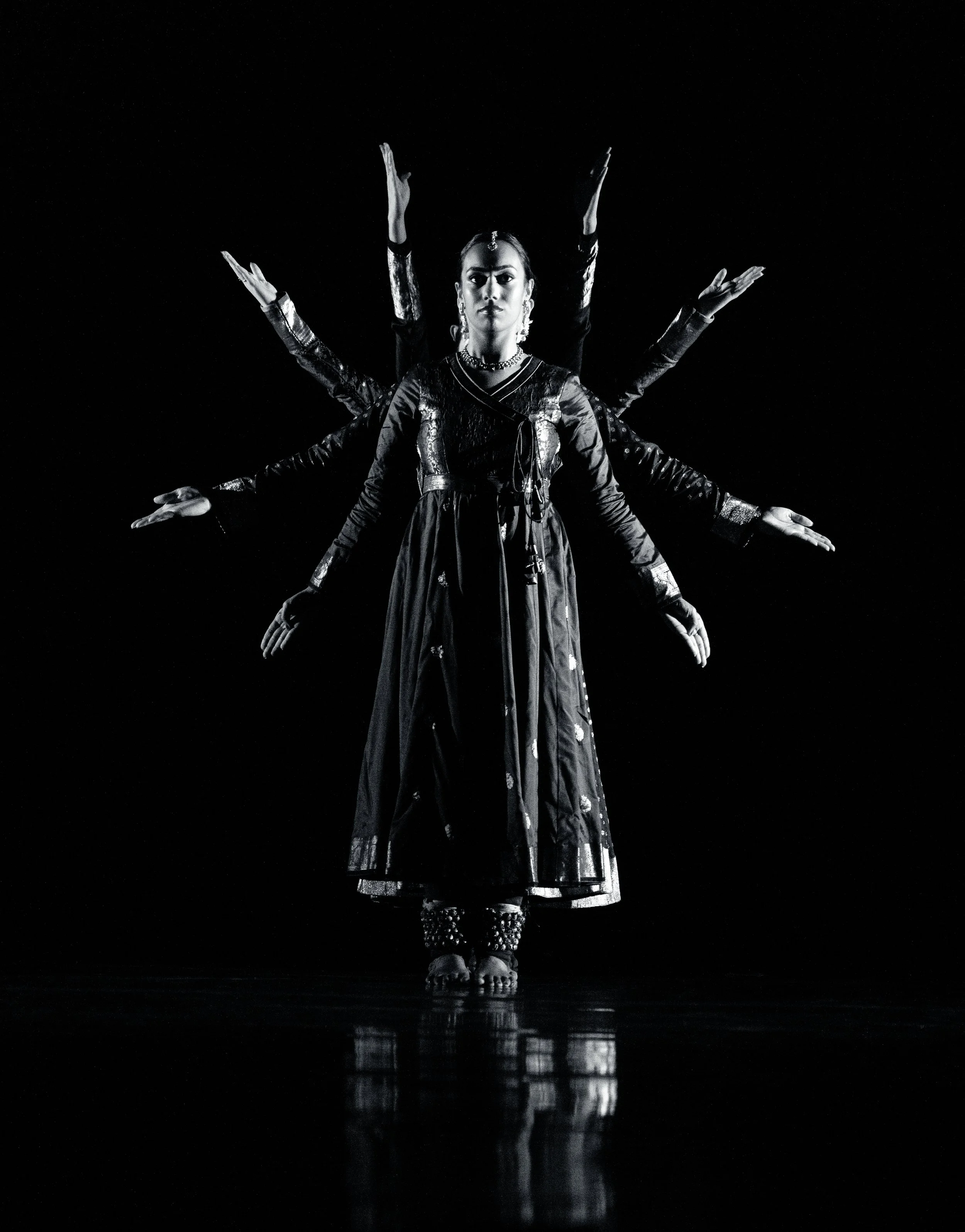
Photography by Palani Mohan.
Since founding the Chitresh Das Institute, she has graduated 24 professional dancers through its rigorous training programme, 12 of whom are now dancing professionally with Chitresh Das Dance.
Innovation as Natural Expression and Exploration
One of the most distinctive aspects of Charlotte's artistic inheritance is her understanding of innovation, not as a departure from tradition, but as its natural expression. Das was himself a constant innovator: he developed new forms of footwork and chakkars, including what the company calls California chakkars. These involved arms curved and extended, whirling up and down during fast stepping turns. The move was inspired, characteristically, by Brian Boitano's jumps at the 1988 Winter Olympics.
Charlotte absorbed not only these innovations but the disposition behind them: the understanding that Kathak, if it is truly alive, cannot remain static. "There has to be an evolution of the art form, or it dies," she says. "He pushed the envelope of Kathak. And if you have a strong riyaaz, you can't help but continue to evolve." Her own choreographic evolution has followed this logic: adapting arms, hastaks, and compositional structures where the music, feeling, or imagery demands it, but always from within the vocabulary of the form. "I see no need to go outside of the Kathak vocabulary," she reflects. "It is so rich, universal in its scope and evolving. It's a deep well of inspiration and a vast ocean of knowledge."
A Choreographic Vision: Environmental Justice, Ecological Grief, and the Stories That Must be Told
“I feel compelled to tell stories that are important to me, and I’ve always been drawn to collaborate with artists who have gone deep into their art.”
Photography by Ravi Kohli.
Charlotte's choreographic practice has always been driven by collaboration and by a pull toward stories that carry genuine stakes. An early duet with tap dancer Chloe Arnold, developed through a Shenson Performing Arts Fellowship, explored the rhythmic kinship between Kathak and Tap. A residency at CounterPulse's Performing Diaspora programme later gave rise to Conference in Nine, a nine-beat composition rooted in a twelfth-century Sufi poem, created with Carnatic-Jazz saxophonist Prasant Radhakrishnan.
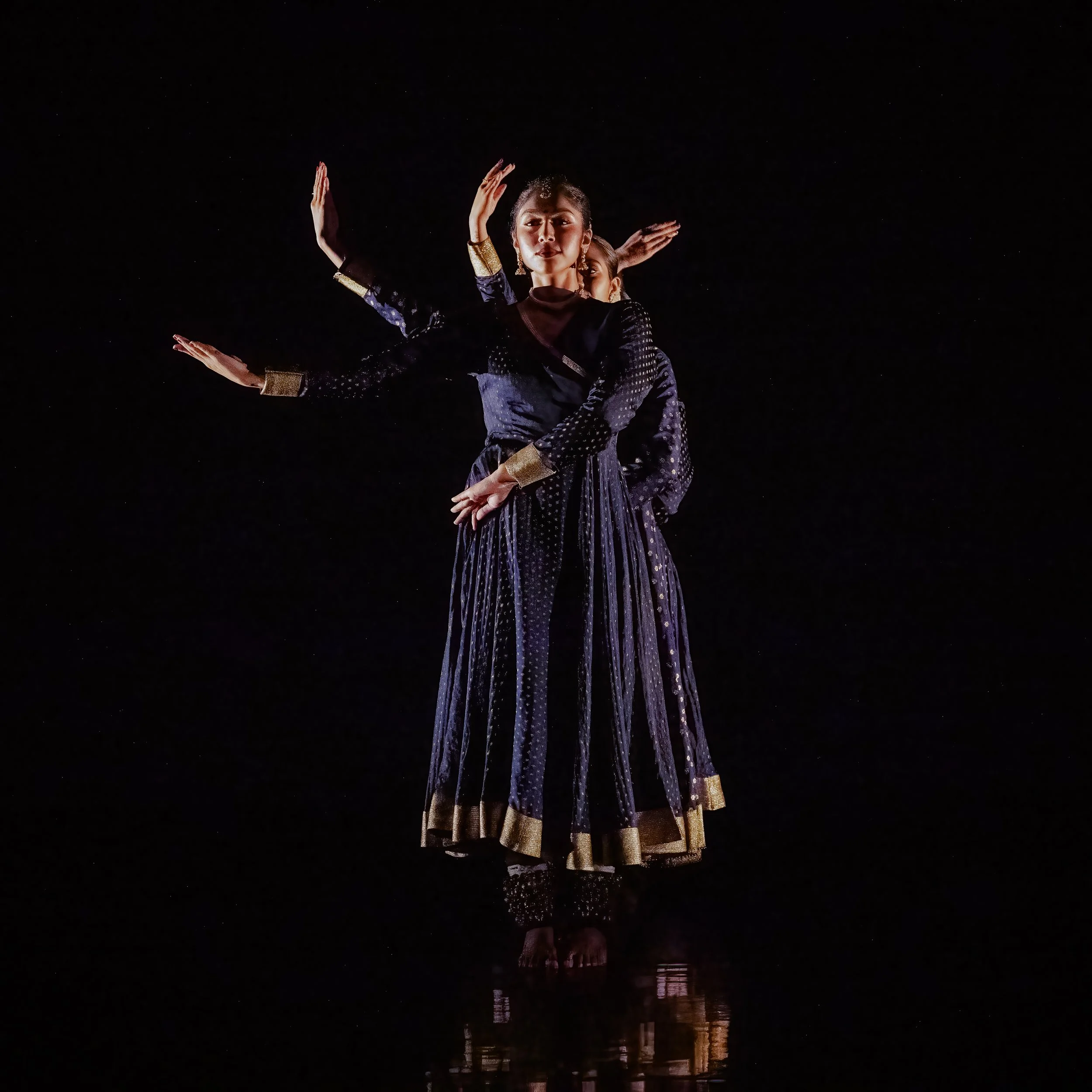
Over the past five years, that impulse has deepened into an extended engagement with environmental justice: a body of connected works that ask, through the language of Kathak, how we understand our relationship to the natural world. Aranya Katha drew on the story of Amrita Devi, an eighteenth-century Rajasthani woman who gave her life to protect trees. Mantram, created with sarod master Alam Khan, used the Maha Pancha Bhuta, the five classical elements, as a framework for the ecological and political fires of 2020, its five-and-a-half-beat taal holding the instability of that moment in the very structure of the composition.
Photography by Palani Mohan.
Invoking the River, composed with raga pianist Utsav Lal, examined the rivers of India as simultaneously revered goddesses and depleted, polluted bodies, a contradiction that holds within it a question Charlotte finds urgent and universal. The work was partly inspired by the Te Awa Tupua Act, which in 2017 granted the Whanganui River in New Zealand the same legal rights as a human being, a landmark moment that reframed how a society could relate to the natural world. Crucially, Charlotte gave each dancer in the company the space to create their own solo, asking them first to name the river they felt most connected to, and then to write a poem about it. "This is what my Guruji did for me," she reflects. "This is how the legacy is carried forward." The work has since toured to three cities in India, North Carolina, Texas, and New York.
Her most recent work, Veil of Janki Bai, developed with filmmaker Alka Raghuram and vocalist Saneyee Purandare Bhattacharjee, turns toward the baijis, the courtesans who carried Kathak through periods of profound stigma and hardship. "We wanted to honour them," Charlotte says. "Not to trauma mine, but to show how we can heal, how we can transform ourselves and others through our art. We are her and she is us."
Building The Chitresh Das Institute and Advancing the Form
“Push and nourish and watch them flourish - that is something I take great pride and joy in.”
Photography by Sree Sripathy.
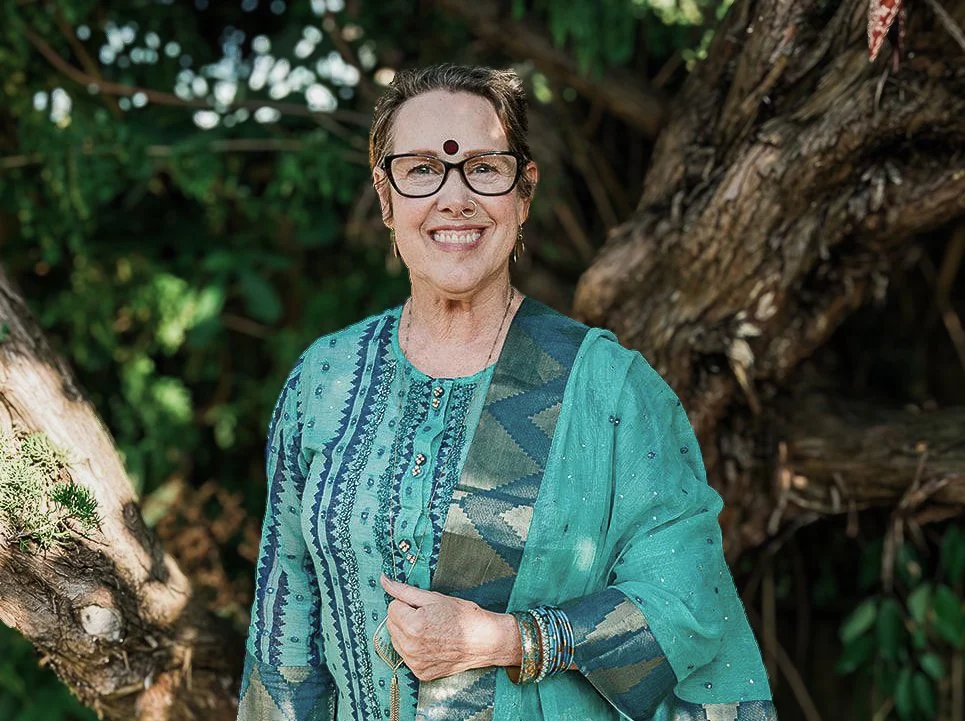
The question of how a classical form sustains itself across generations is, for Charlotte, not abstract. It is the daily reality of running a school and a company in the San Francisco Bay Area. She trains students at every level, from mothers and daughters seeking joy, cultural connection, and togetherness, to the advanced and professional artists coming through the Youth Company track.
Das's tradition, as Charlotte practices and transmits it, demands maximum rigour. But she is clear that rigour alone is not what draws people to the form. "CDI is a place of joy, creation, preservation, and celebration." That breadth, in her view, is essential. Not everyone who enters a Kathak classroom is seeking the path of the professional artist. That too is valid. What matters is that the space holds both: the joy of participation and the rigour of deep formation, simultaneously and without contradiction.
For those who do pursue the professional path, Charlotte is unflinching about what it requires. "Kathak requires a serious time commitment: a period of obsessive taalim. Once you go through that, you can't let it go." And once an artist has something genuine to say, the form, she believes, is more than capable of holding it. "I have found that Kathak has no boundaries. You can bring all your experiences to express yourself through your dance, but you must stay true to what you have learned, and to the community that has supported you along the way."
What she wants to see more of, looking ahead, are the structural conditions that allow that depth to develop: fellowships, residencies, and creative incubation opportunities for Kathak artists.
More than thirty years into a practice that began with a serendipitous encounter in a university classroom, Charlotte Moraga continues to ask more of the form, and of herself. The institution, the dancers she has trained, the works she has made: all of it is in service of something larger than any single career. "Sam keeps coming around, full circle," she says. "If you are a Kathak dancer, you must find sam." The tradition, as she received it, demands nothing less.