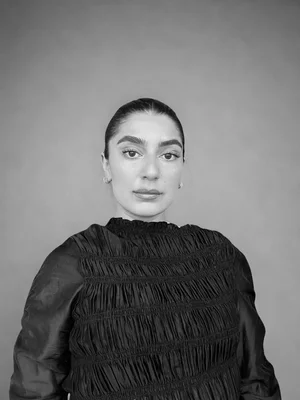
Tarini Tripathi on the Grammar She Inherited and the Language She Is Making
In conversation with Mumbai-based Kathak artist and choreographer Tarini Tripathi — on dancing as a third-generation artist, the world premiere of Beej at NMACC Mumbai, and what it means to honour a form while finding your own language within it.
Written by Simi Kaur
All images courtesy of Tarini Tripathi
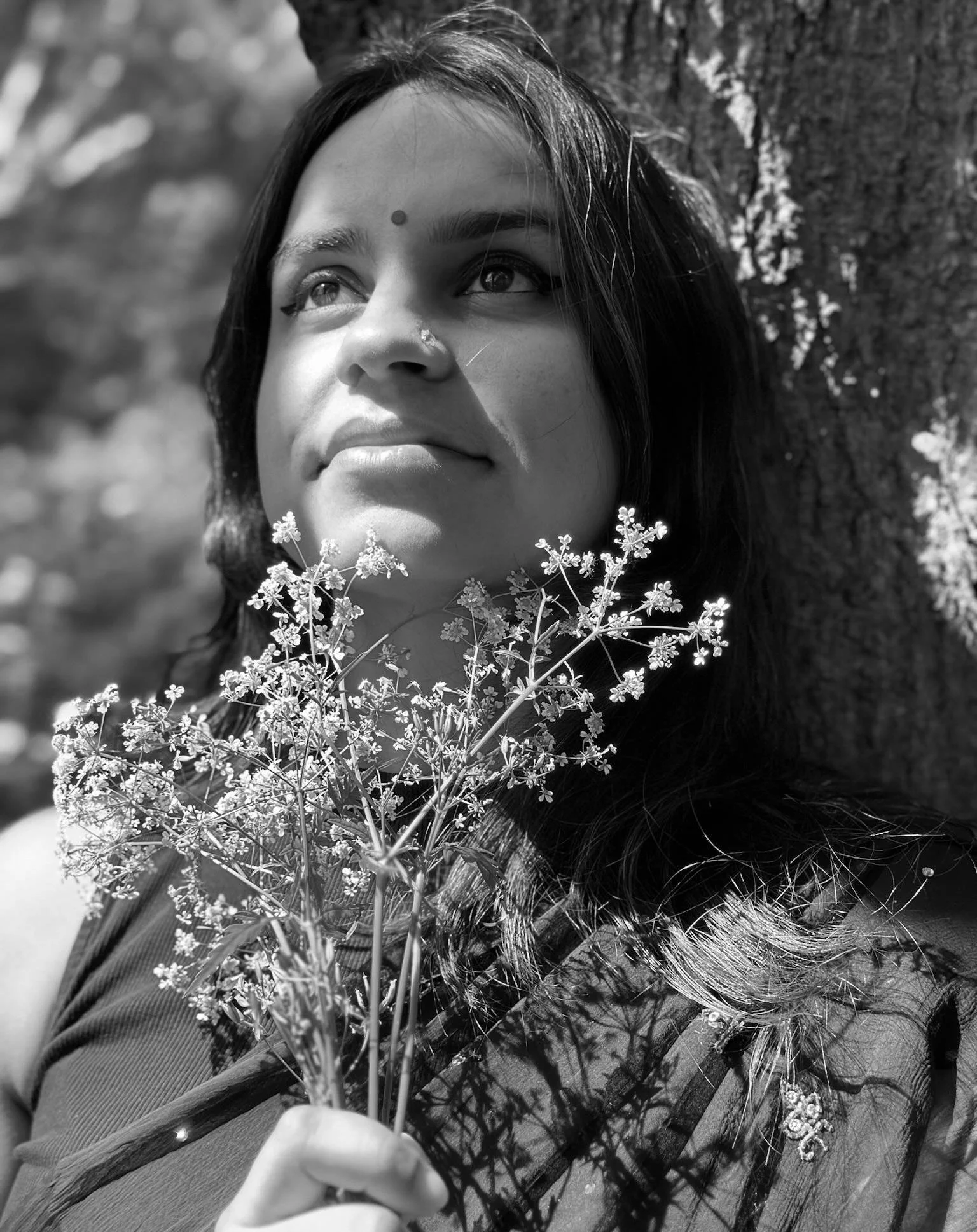
Photography by Tarini Tripathi.
“Coming from such a strong female lineage in Kathak has really shaped my foundation.”
For Tarini Tripathi, Kathak is not simply a discipline she has chosen — it is the world she was born into. The granddaughter of Padma Sharma and daughter of Gauri Sharma Tripathi, she has trained within the same female line of teachers that has shaped her since childhood, later formalising that practice with a Masters in Performing Arts (Kathak). Far from feeling constrictive, that inheritance has been, for her, a source of creative freedom. "Coming from such a strong female lineage in Kathak has really shaped my foundation," she reflects. "It gives me the freedom to explore different aspects of the form, while still staying rooted in its grammar and vocabulary."
Kathak was always present in Tarini's life — absorbed through proximity as much as through formal training. Though she began in a more structured group class setting, her immersion extended well beyond the classroom, shaped by the rhythms of a household steeped in the form. "It felt very much like the traditional Guru Shishya parampara," she says. Yet the decision to pursue Kathak full-time was not automatic. It came later, at a point of personal reckoning — a moment when she found herself asking who would carry her family’s relationship with the form into the next generation. That question, and her response to it, became a turning point.
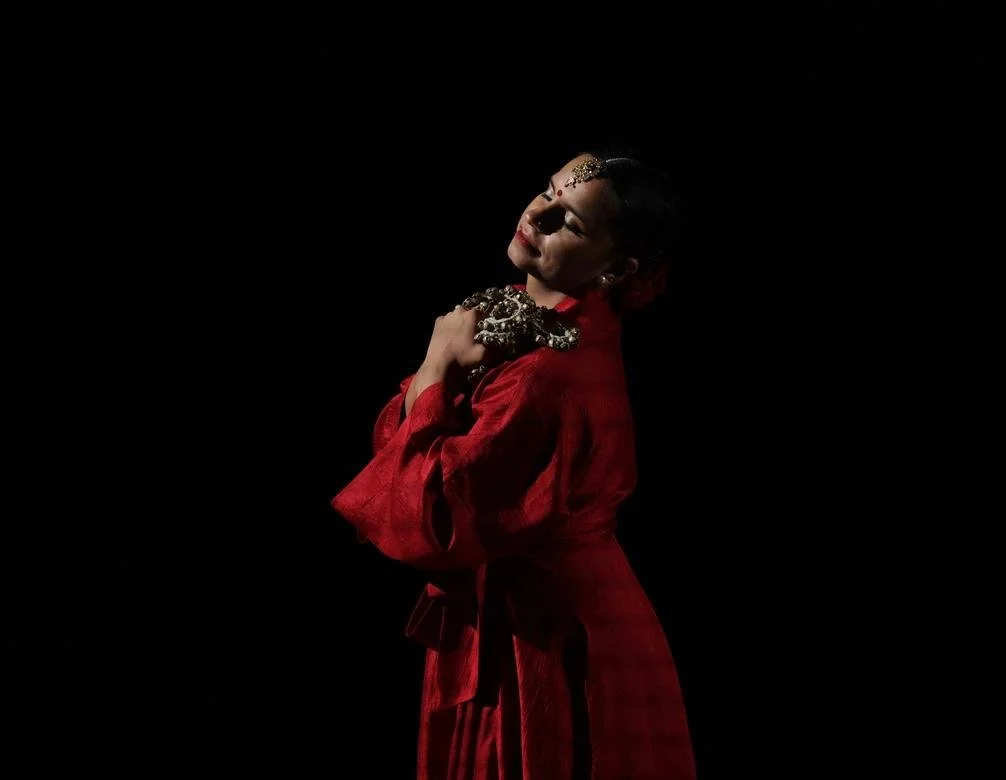
Photography by Nita Mukesh Ambani Cultural Centre.
Today, what grounds her is the daily practice itself. "What really grounds me is my riyaaz — that daily, intentional practice that brings me back to the essence of Kathak," she explains. Alongside this, she has developed a deeper attentiveness to her own body: learning to listen rather than force, to let movement emerge from within rather than be imposed upon it. "I've also become more aware of listening to my body, allowing it to guide my movement and thought, rather than forcing it. That's something that has evolved a lot over time." Her gaze, she notes, extends beyond Kathak itself — other dance forms continue to offer her new ways of seeing, and she remains conscious of a widening field of influence, from watching senior artists move to observing how the body changes and deepens across a lifetime of practice.
The Risk of Returning
“Returning to my foundational training with my gurus is, in itself, a risk. It demands unlearning, relearning, and a certain vulnerability.”
For Tarini, the notion of artistic risk within Kathak resists easy definition. It is not simply about novelty or experimentation — it is a more continuous and demanding negotiation, one that unfolds at every level of practice. "For me, taking artistic risks within Kathak is about revealing the nuances of the form in new and unexpected ways, while remaining deeply anchored in its technique and in my own embodied understanding of it," she explains. "It's a constant negotiation between tradition and exploration, between what is inherited and what is discovered."
Notably, she locates one form of risk not in departure but in return. Going back to her foundational training with her teachers — unlearning, relearning, submitting once again to the rigour of the form — carries its own kind of vulnerability. "On a technical level, I often find that returning to my foundational training with my gurus is, in itself, a risk. It demands unlearning, relearning, and a certain vulnerability, each time pushing me to refine, question, and deepen my practice."
Creatively, for Tarini risk takes the form of reimagining — approaching familiar narratives, characters, and concepts from angles that have not previously been explored, while preserving the essence of the form. She is equally drawn to placing herself in unfamiliar terrain: experimenting with new movement vocabularies, performing in unconventional spaces, working alongside artists from other disciplines and traditions. Collaborations — with folk musicians, contemporary dancers, filmmakers — have been especially generative. "These experiences not only challenge my assumptions but also offer new impulses that I can absorb and translate back into my Kathak practice," she reflects.
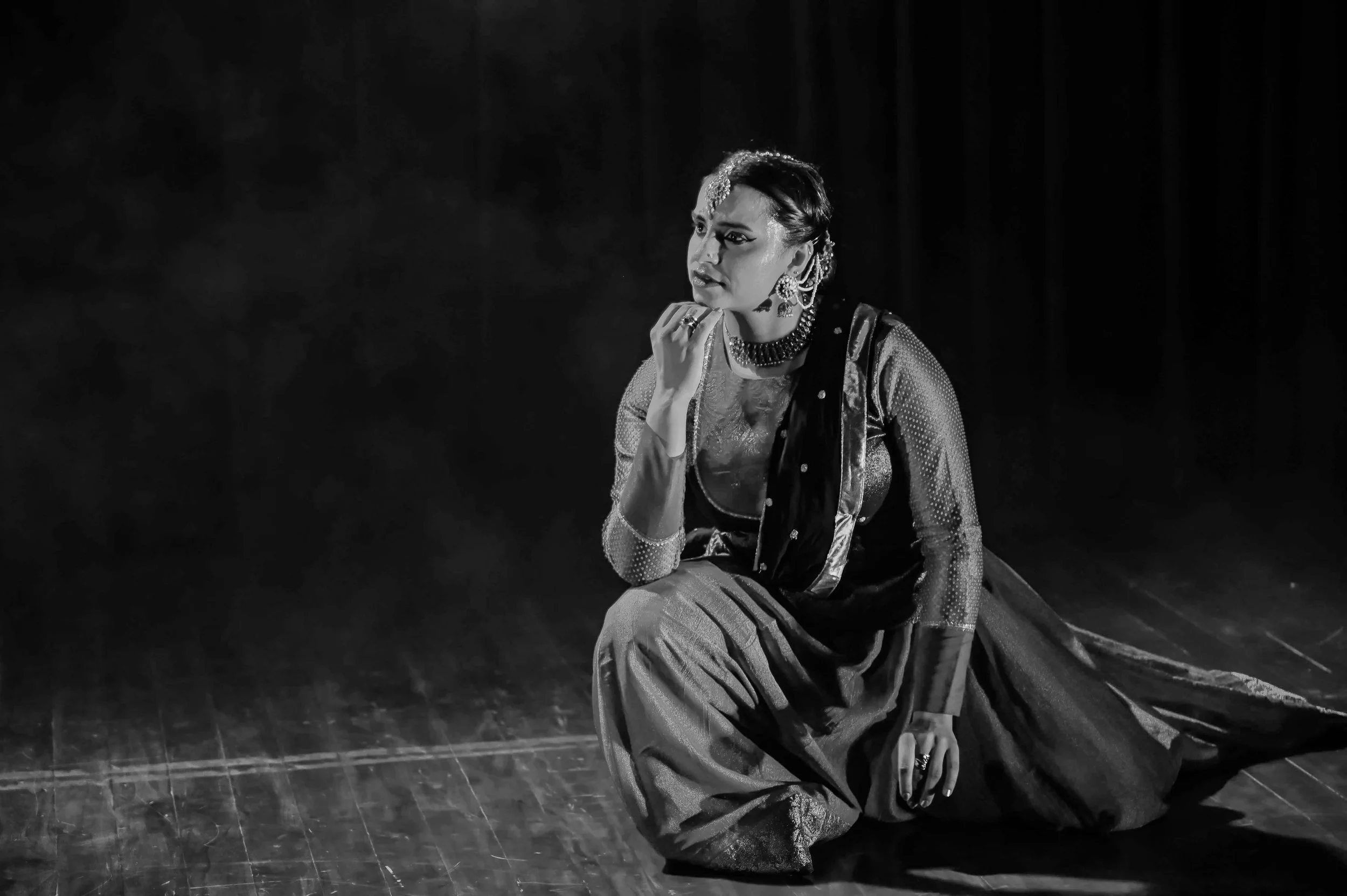
Photography by Samved Society.
Beej: The Art of Collaboration and a World Premiere at the NMACC
Tarini's most recent work, Beej, offers a vivid illustration of these principles in practice. Supported by AF Entertainment, Lohani Dance Theatre and ANKH Dance, and premiering at the Nita Mukesh Ambani Cultural Centre (NMACC) in Mumbai, the piece draws on the mythological figure of Sita — not as a devotional subject, but as a lens through which to examine humanity's relationship with the natural world. Sita, born of the earth and daughter of the earth, becomes in Beej a representation of the environment itself. Her choice to cross the Lakshman Rekha — the protective boundary she was warned never to breach, and the decision that sets the entire arc of the Ramayana in motion — is reframed as an analogy for the environmental choices we all face and the consequences that follow.
The work was created in collaboration with contemporary dancer and choreographer Neeraj Lohani, with dramaturgy guided by Gauri Sharma Tripathi. The development process began with just the two choreographers, working through concept, storyline, storyboard, and movement before bringing the wider company of dancers into the studio. What followed was, by Tarini's account, genuinely fluid. "Movements would emerge, and we would observe how the body responded," she explains. Some sections were intentionally left open in terms of style; others were more deliberately assigned. Suggestions flowed in both directions — an ongoing exchange of trying something, responding to it, refining it. "This exchange happened both ways, and that's essentially how the process evolved."
What makes Beej particularly striking is the deliberateness with which its two choreographic languages are held. Rather than blending classical and contemporary vocabularies into a unified hybrid, Tarini and Neeraj preserved the distinctness of each form while allowing them to meet. She brought her grounding in Kathak; he brought his contemporary sensibility. The result was a movement language in which both could coexist — seamlessly, but without compromise.
Premiering at NMACC was, for Tarini, an honour in its own right. The venue's technical infrastructure and support staff gave the production room to think about set design in a far more integral way than might otherwise have been possible — though she is clear that the space itself did not alter the choreography. "It lends itself to the art of the artist and the audience," she says. Beej is her second original work, sitting outside the traditional Kathak repertoire entirely, which gave her a wider creative latitude. "It allowed me the space to explore and create more freely," she notes.
Kathak in an Evolving Landscape
“As artists, we’re constantly negotiating between tradition and innovation, figuring out how to evolve without losing the essence of the form.”
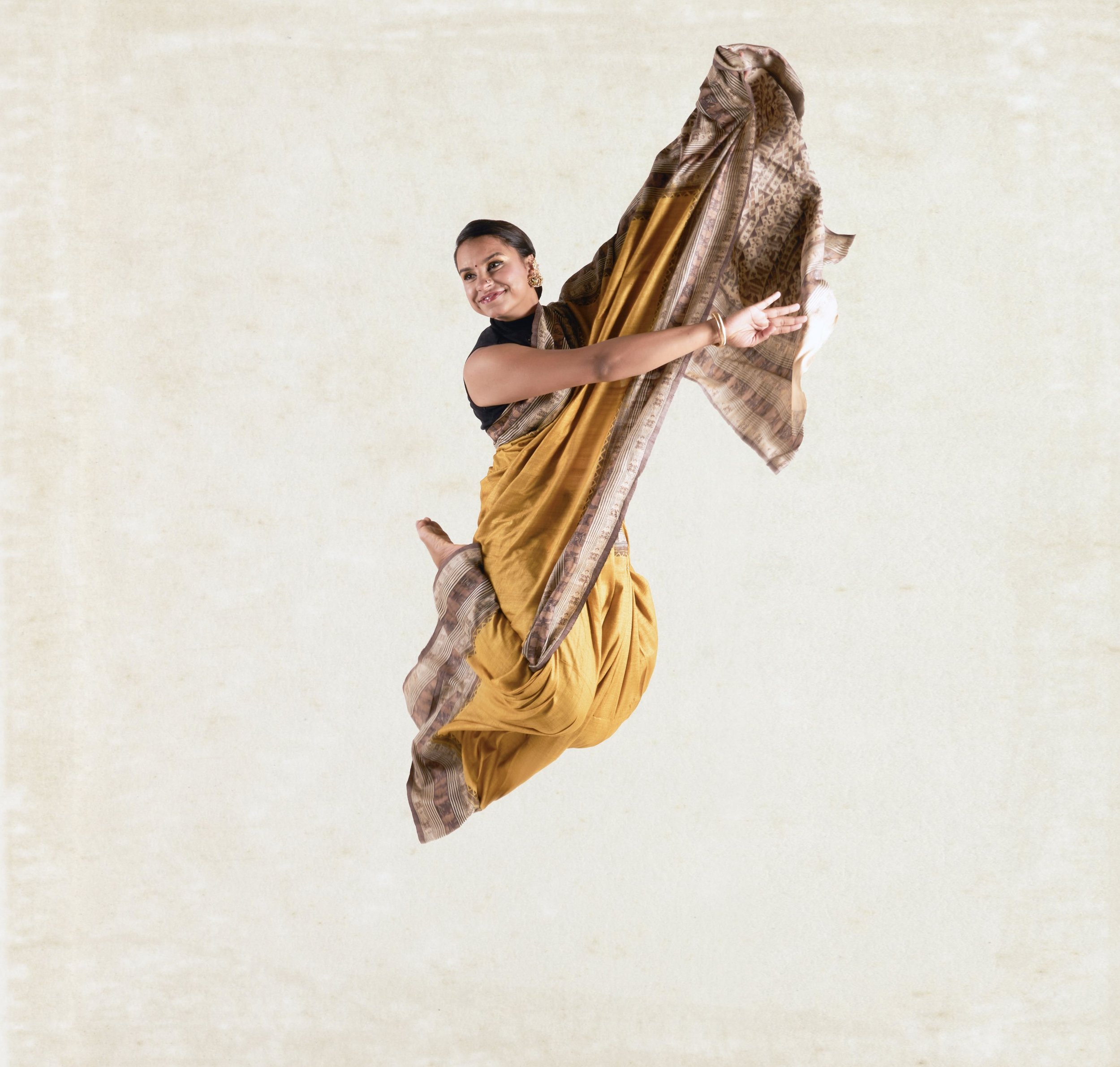
Photography by Simon Richardson.
Watching Kathak evolve from her vantage point in Mumbai, Tarini is alert to the scale and complexity of the changes underway. The digital space has fundamentally altered who can access the form and how it is transmitted — collapsing geographical distances, drawing in students from across the world, and bringing with them a wider range of perspectives and experiences. Audiences, too, have shifted: more diverse, more curious, and increasingly open to new interpretations, even as they continue to value Kathak's traditional roots.
Yet she is candid about where she feels the gaps remain. Wider online access has not necessarily translated into wider live audiences. "I do still feel that Kathak needs to be more accessible in the offline format — via performances. We need more audiences for shows," she says plainly.
She is also observing a growing culture of collaboration — among Kathak dancers themselves, and across artistic disciplines more broadly. These exchanges are expanding the form's movement vocabulary and opening up new approaches to storytelling and performance. At the same time, they place new demands on artists: to remain anchored in their own practice even as they reach across into other worlds. Underlying all of this, Tarini identifies a deeper philosophical negotiation she believes sits at the very heart of Kathak's evolution today. "As artists, we're constantly negotiating between tradition and innovation, figuring out how to evolve without losing the essence of the form. And I think that balance is what's really shaping Kathak's future today."
Building a Stronger Ecosystem
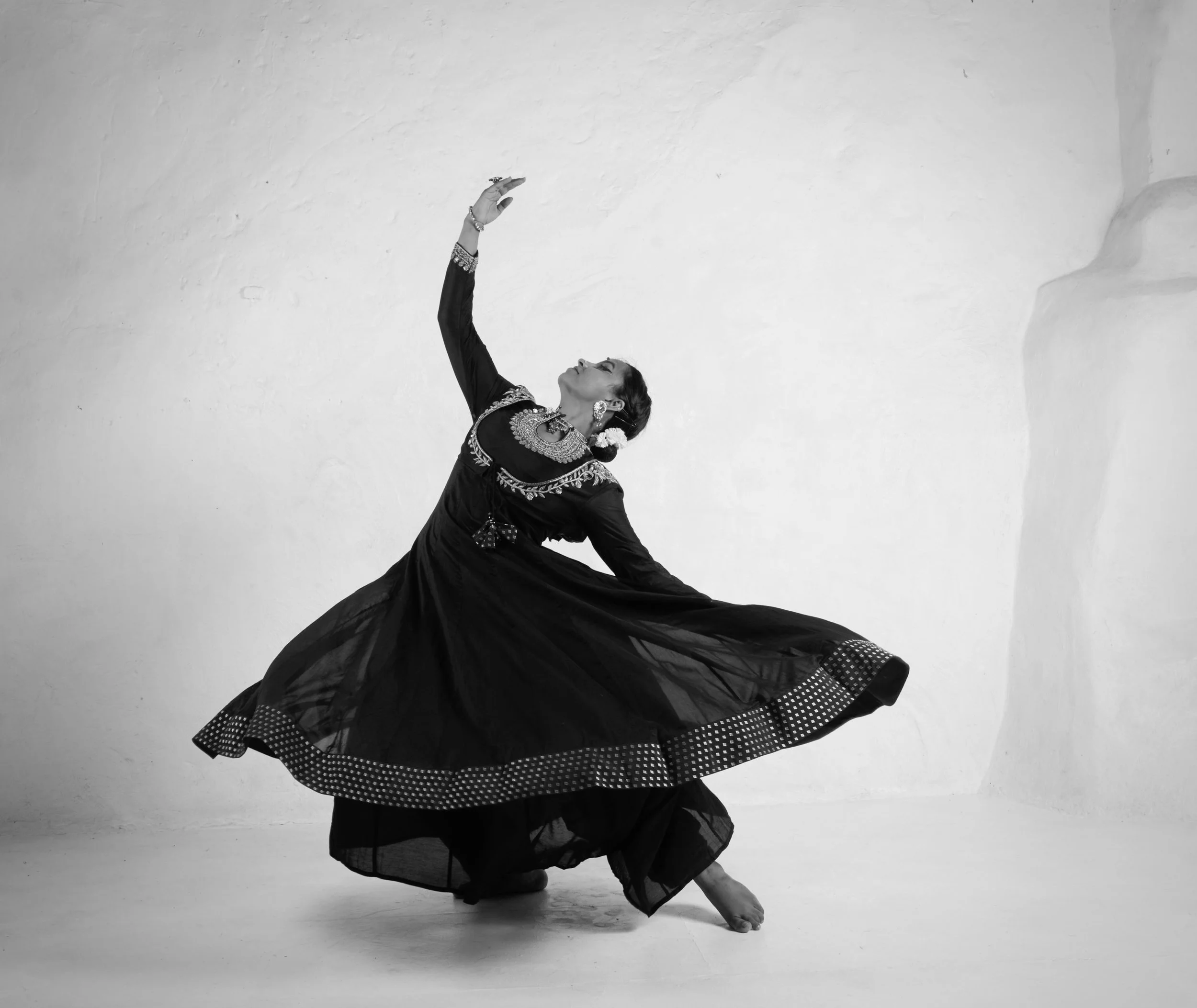
Photography by Simon Richardson.
When Tarini turns to what she hopes to see develop for Kathak dancers, her thinking is both visionary and grounded. She wants to see more collaborative work among Kathak dancers themselves, alongside a stronger culture of knowledge-sharing within the wider community. Research and development grants, commissioned work, and greater formalisation of basic payment structures within the industry are all, for her, essential building blocks. "I also believe in building a stronger ecosystem that supports artists, so they don't have to manage every aspect of their work on their own," she says — acknowledging that this shift is slowly beginning to take shape.
Alongside the structural, she remains committed to the artistic. Tarini explains that a deeper focus on technique and the quality of dance must sit alongside expanded performance opportunities for artists at every stage of their careers, supported by both public and private organisations. Senior mentorship programmes, too, have a vital role to play in ensuring that the knowledge held within the form's most experienced practitioners finds its way to the next generation.
For Tarini Tripathi, the work ahead is inseparable from the work already done. Rooted in generations that have shaped her body, her thinking, and her sense of responsibility to the form, she brings to Kathak both the weight of inheritance and the lightness of creative freedom.