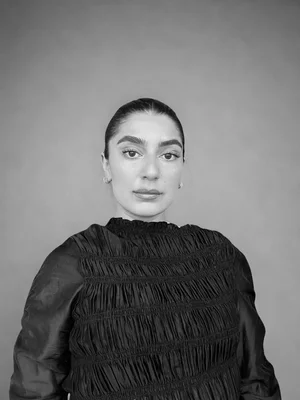
Saloni Saraf on Kathak in the Digital Age, the Courage to Evolve and a Landmark Night at the BBC Proms
In conversation with Mumbai-based Kathak artist and choreographer Saloni Saraf — on finding her artistic voice, the courage to evolve, a landmark night at the BBC Proms, and what it means to create with integrity in the digital age.
Written by Simi Kaur
All images courtesy of Saloni Saraf
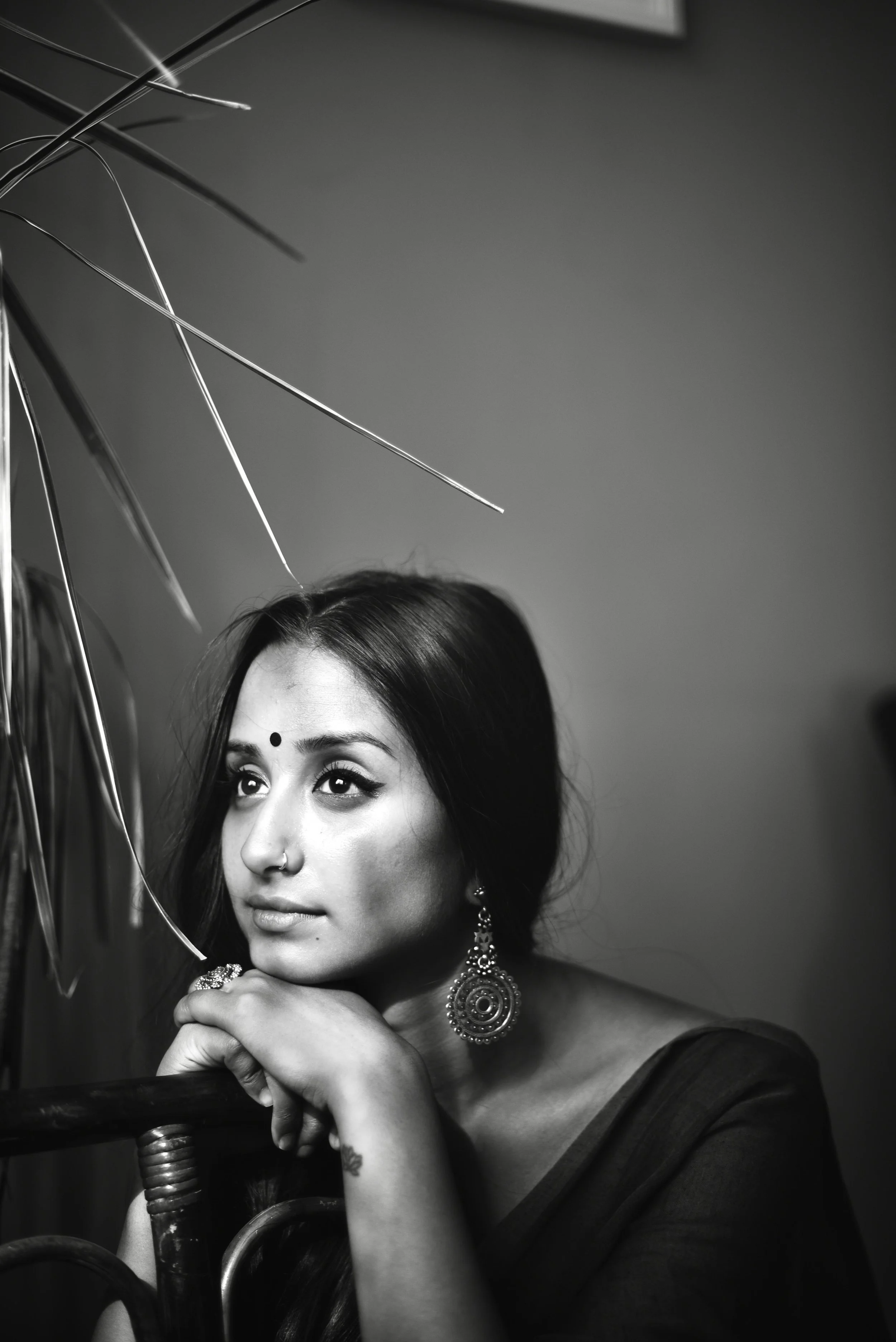
Photography by Urvi Desale.
Walking onto the stage of the Royal Albert Hall is the kind of moment most dancers only dream of. For Saloni Saraf, it arrived as something more — a convergence of lineage, devotion, and a form she had spent years learning to call her own. But before that night, there was a beginning marked not by confidence, but by fear.
"Initially I was scared of the form," Saloni reflects, "deeply intimidated by its rules, technique, history, depth." But fear eventually gave way to something more liberating. "As soon as I let my joy of dance take over, I learnt that the style is what you make it, without taking away from its core values and structure." Kathak, she came to understand, was not a fixed or forbidding structure, but a living language — one that had been evolving for centuries, and one that could continue to evolve through her. Today, she describes her practice as an amalgamation: of her inspirations, her teachers, her understanding of her body, and her own sense of what dance can be. "As an artist," she says, "I am an amalgamation of all that inspires me, and the Kathak that I practice is an amalgamation of everything I have learnt from all my teachers."
Finding Her Ground: On Becoming a Kathak Artist
Saloni's development as an artist has been shaped by two distinct and complementary forces. Her two teachers — Gauri Sharma Tripathi, based in Mumbai, where Saloni now lives and continues to train, and Sujata Banerjee MBE in London — whom she affectionately and respectfully refers to as her gurus, have together been the bedrock of her development as a Kathak artist. Kathak, she reflects, has not simply been a discipline she has pursued; it has been a companion to her own coming of age, evolving alongside her personality and her deepening understanding of both her body and the form itself. “
"I've been blessed to have two gurus," Saloni says, "both powerhouse women who have taught me everything from strong technique to performance quality, understanding the anatomy of a body, to breaking out of [my] comfort zone." The dual lineage — one shaped by Mumbai's dynamic artistic scene, the other by London's South Asian creative landscape — has given Saloni what she describes as an early and intimate familiarity with the blend of traditional and contemporary structures. "I've been thrown into that very blend from a very early age," she reflects, "so I don't know any different."
Both teachers have guided and supported her as her relationship with the form has evolved and deepened. What grounds her today is the richness of that training, and a sense of freedom she has consciously given herself — to dance in a way that feels true to who she is. "What grounds me today is the rich training from my teachers, and a sense of freedom that I have given myself to dance in a way that feels true to me."
The Courage to Evolve Through Creative Inquiry
For Saloni, artistic risk begins with a willingness to question what is considered normal or comfortable within a form. "I think anything that challenges the current status quo of a form, or what is seen as 'normal' or 'comfortable' is an artistic risk," she explains — whether that means collaborating with artists from other disciplines, reimagining traditional narratives, or creating cross-disciplinary work that pushes the form into new territory.
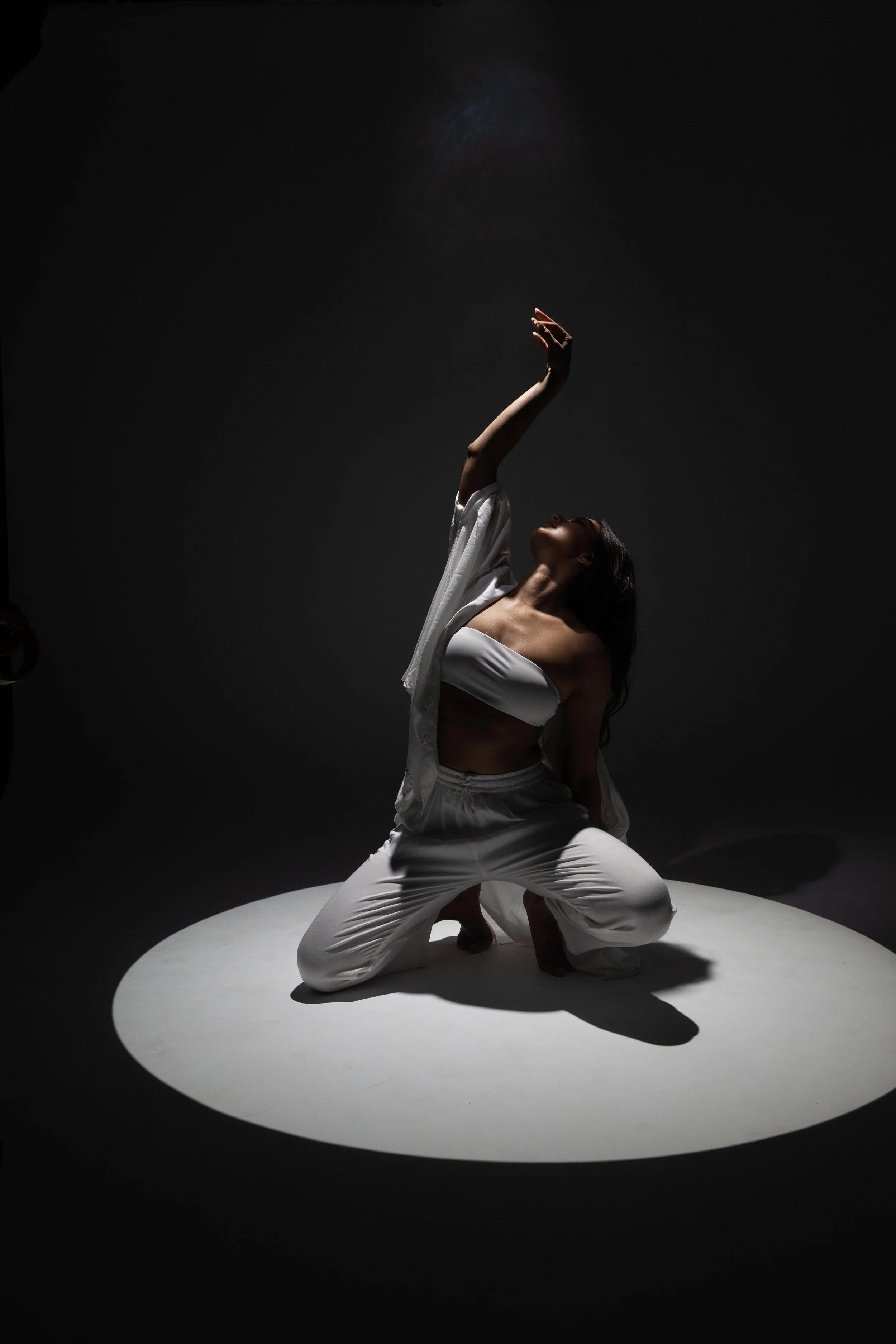
Photography by Arjun Doshi.
A consistent thread running through her creative practice has been a fascination with both mythology and the deeper history of Kathak itself. Rather than accepting traditional stories at face value, she approaches them through a more progressive lens — drawn to the questions that lie beneath, and what they might truly mean beyond their traditional interpretations. One of her earlier works saw her reimagining the Radha and Krishna narrative. Using the thumri 'Tum Radhe Bano Shyam', she and a fellow dancer raised a profound question. "Perhaps [Radha] never was a real person?" Saloni asks. "Krishna as we know was an androgynous being, was Radha just a physical manifestation of his female energy that we turned into a character for the sake of our storytelling?" The response, she recalls, was mixed. But it was, she says, "the beginning of my journey of taking artistic risks" — an early lesson in what it means to stay true to an artistic vision regardless of whether every audience is ready to receive it.
More recently, her choreographic interests have moved toward telling stories from within Kathak's own history — the world of the courtesans, the lineage of the thumri. "Sometimes contemporary storytelling doesn't have to be exclusive to movement," she notes, "it could just be about the structure of the performance. Everything from the dramaturgy, music, script, and characters." For Saloni, being a malleable body — one that can adapt to any room, any choreographer, any set of bodies — is as essential a skill as technical mastery. "The traditionalism is in maintaining your strength and confidence in your style," she says, "the contemporary structure is in the ability to let go of it when required."
A Landmark Night at the BBC Proms
“the opportunity to perform a solo, to some of my all time favourite songs, accompanied by the City of Birmingham Symphony Orchestra was nothing short of a dream come true.”
If there is a single moment that crystallises what Saloni's practice has been building toward, it is her performance at Prom 18 of the BBC Proms 2023 at the Royal Albert Hall — a career highlight she describes as one of the most significant of her life.
Forming part of the BBC Proms' annual summer season, the evening was a full tribute to the legendary singer Lata Mangeshkar, performed alongside the City of Birmingham Symphony Orchestra. Saloni performed on behalf of The Bollywood Company, a dance company she freelances for as both dancer and choreographer, and was invited by its director, Nileeka Bose, to perform a solo. For a Kathak dancer with a long-standing fascination with the era of the courtesans, the invitation carried enormous personal weight. "As a Kathak dancer, the era of the courtesans has been something that I have always admired…" she recalls, "so getting the opportunity to perform a solo, to some of my all time favourite songs, accompanied by the City of Birmingham Symphony Orchestra was nothing short of a dream come true."
What followed was a preparation that felt, in her words, as though the stars were aligning. Saloni's teacher, Gauri Sharma Tripathi, is the daughter of Padma Sharma — herself a disciple of Lachhu Maharaj, one of the great masters of the Lucknow Gharana of Kathak and recipient of the Sangeet Natak Akademi Award, who choreographed the original dance sequences for Pakeezah. Padma Sharma had taught Meena Kumari some of the film's most iconic dances, including 'Thare Rahiyo O Banke Yaar' and 'Chalte Chalte Yun Hi Koi'. Saloni flew to India and spent a month with both Gauri Sharma Tripathi and Padma Sharma, learning to pay respect to the songs in the most authentic way possible.
“We focused on Meena Kumari’s ‘therav’, ‘bhaav’, ‘ang’, and the rhythm behind the songs.”
"We focused on Meena Kumari's 'therav', 'bhaav', 'ang', and the rhythm behind the songs," she explains. "Padma ji broke down each lyric, its duality in meaning, which is something we often practice in Kathak, and patiently created a beautiful choreography to both the songs." The hours spent listening to stories from that era became as formative as the choreography itself, helping Saloni fully inhabit the character she was preparing to bring to one of the world's most storied stages.
The production details were considered with care. Floor microphones were installed so that her ghungroos could be heard alongside the orchestra — allowing her bells and the rhythm they carried to complement the City of Birmingham Symphony Orchestra's sound, particularly in 'Chalte Chalte Yun Hi Koi'.
“...as I looked out into the audience of the Royal Albert Hall, I have never felt more gratitude towards my journey as a classical dancer.”
"Walking onto stage that day was a feeling I'll never forget," she says. "I didn't let my nerves take away from fully experiencing the moment and as I looked out into the audience of the Royal Albert Hall, I have never felt more gratitude towards my journey as a classical dancer. The six and a half minutes on stage felt like a lifetime and I danced my heart out, just like a courtesan from another era."
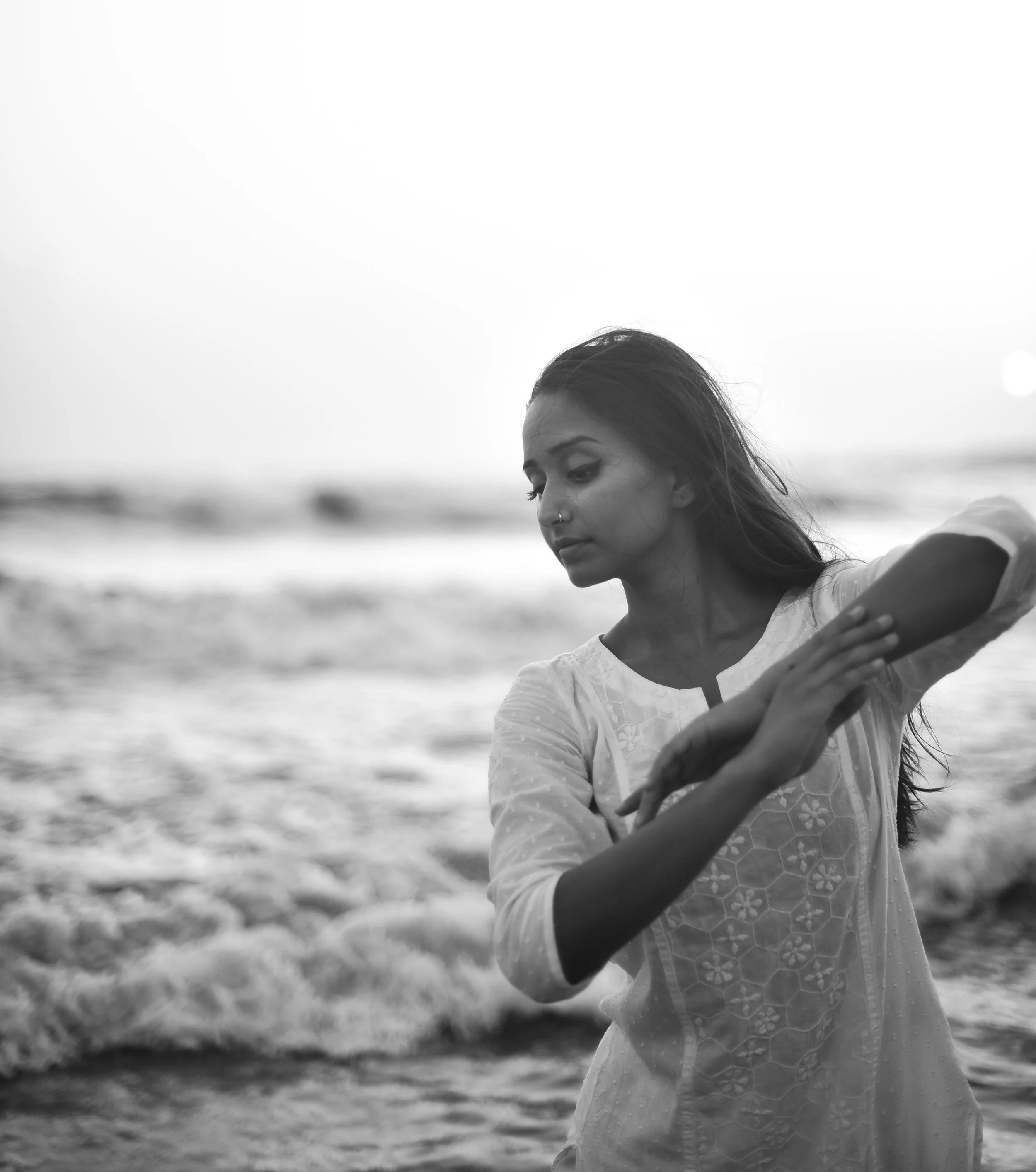
Photography by Urvi Desale.
Artistic Integrity in the Digital Age
Beyond the stage, Saloni has thought carefully about what it means to be a Kathak artist in an era shaped by social media and what she describes as a pervasive workshop culture. Her perspective is considered and, at times, deliberately counter-cultural.
She is clear-eyed about the double-edged nature of the digital landscape. On one hand, access to global art and ground-breaking choreographers has expanded creative possibility. "Contemporary and classical choreographers are working together to create new genres of dance," she observes, "and the potential for groundbreaking work on stage, across styles, in a collaborative and educational sense is greater than ever." On the other, she is candid about what an algorithmically driven culture of consumption does to the space that long-form art requires. "Long form art is harder to palette for a lot of audiences, unless they've bought a ticket to a theatre," she observes — a reality that has particular implications for a form as layered and demanding of attention as Kathak.
“Having five people watch something that is true to who you are as an artist vs five hundred people watch something you don’t believe in, is a choice I’ve made.”
Her most pointed concern is reserved for what she calls 'workshop culture' — the post-pandemic proliferation of short-form online learning that, in her view, has taken a negative toll on the sanctity of deep training within any form. And yet she is not dismissive of social media as a tool. Rather, she is insistent on the question of intent.
"If you're focused on increasing followers and having lots of 'viral' work then you will fundamentally shift your focus from what you want to do to what the audience wants to watch," she says. The alternative, she argues, is slower but more sustaining: staying true to your artistic identity, and trusting that the right audience will find you for what you believe in. "Having five people watch something that is true to who you are as an artist vs five hundred people watch something you don't believe in, is a choice I've made."
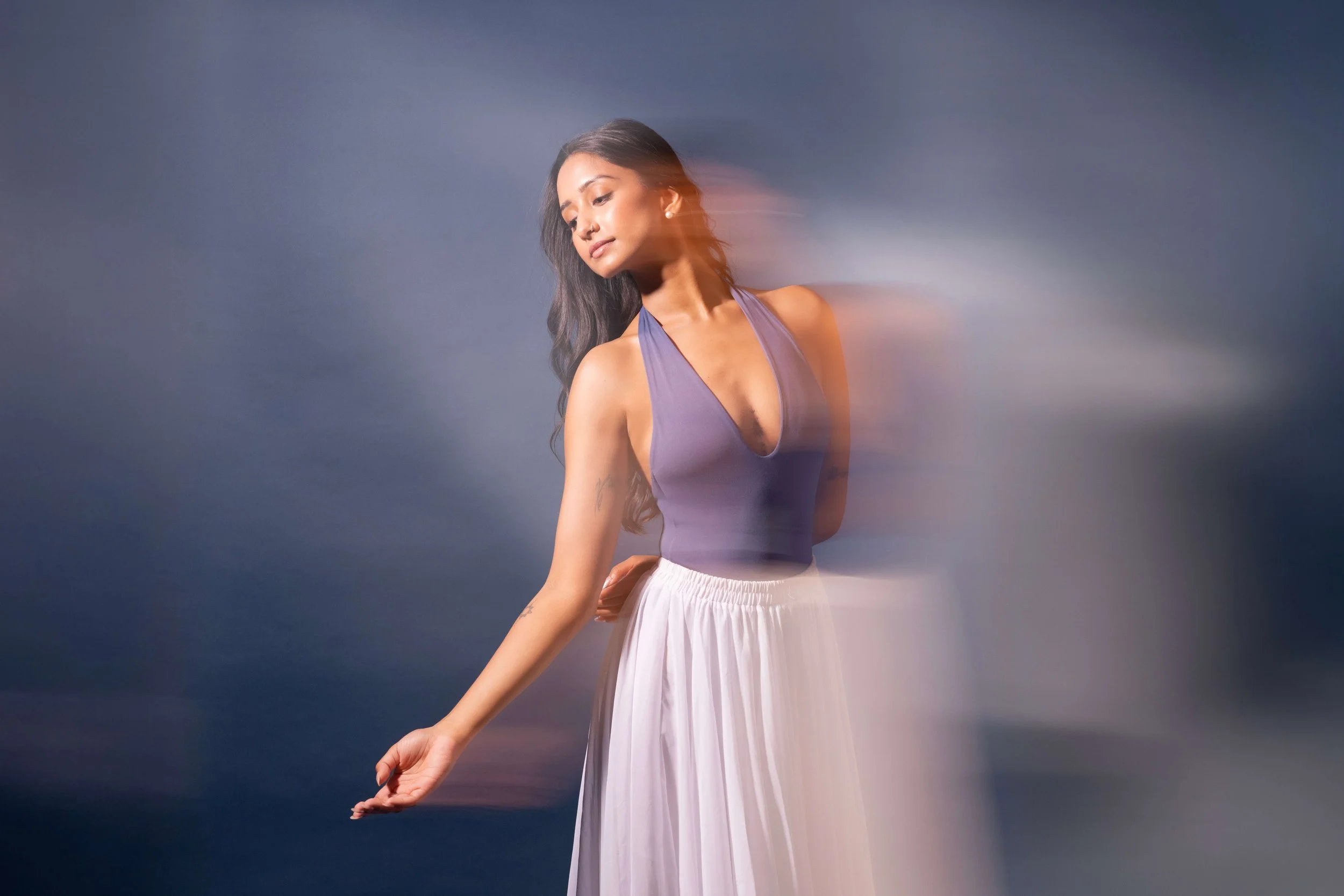
Photography by Deepak Das.
Since relocating to Mumbai, Saloni has found herself reconnecting with something essential — the love of dance that first drew her to the form, before external pressures began to compete with that original calling.
"Ever since moving to Mumbai last year I've managed to rediscover what made me choose to become a dancer long before instagram ruled the world." She is candid that the following she has built online has been genuinely significant, opening doors and generating work that has shaped her career. What she resists is allowing that following to become the pillar of her artistic choices. "It's about finding the balance between dancing to show the world, or showing the world why you dance."
Grounded in two great teaching lineages that have profoundly informed her practice and artistic voice, Saloni Saraf embodies what it looks like when a dancer moves through tradition with both reverence and curiosity. She is an artist who asks difficult questions of the stories she tells, and who measures success in authenticity — a reminder that Kathak, at its most vital, has always belonged to those willing to engage with it honestly and deeply.